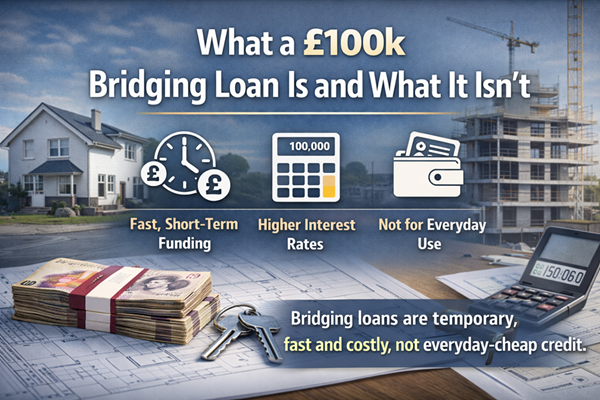
Bridging loan is short-term finance which has been secured on property. It’s designed to “bridge” a gap when you need the money fast, until longer-term finance (like a mortgage) or a sale completes.
Typical costs & current rates
2025/26 UK bridging loan interest rates are significantly higher than standard mortgages and are quoted monthly rather than annually like a regular loan:
- The typical rate for a bridging loan ranges from around 0.5% to 1.5% per month, however, this can depend on loan-to-value (LTV), the property type and the exit plan you have in place.
- Some lenders can start even lower (from 0.44 – 0.55% per month) for very strong cases.
Lets look at a common £100K bridging example:
| Item | Value |
|---|---|
| Purchase Price (Security Property) | £165,000 |
| Loan Requested | £100,000 |
| Term | 6 months |
| Net LTV | 61% |
| Interest Rate | 1.5% per month |
| Monthly Interest | £100,000 × 1.5% = £1,500 |
| Total Interest (6 months) | £1,500 × 6 = £9,000 |
| Lender Arrangement Fee (1%) | £100,000 × 1% = £1,000 |
| Loan Amount | £100,000 |
| Arrangement Fee | £1,000 |
| Total Interest | £9,000 |
| Total to Repay | £100,000 + £1,000 + £9,000 = £110,000 |
For a 100k bridging loan at an interest rate of 1% per month, you would be paying roughly £1,000/month in interest, before any fees.
This can add up fast if you hold the loan for a long amount of time, this is why bridging finance is meant to be taken out for a short period of time (usually between 1 – 12 months).
Other costs to budget for:
- Arrangement fee: This is typically 1–2% of the loan
- Valuation fee
- Legal/solicitor fees
- Redemption admin fees
Common uses of a £100k bridging loan
Bridging loans aren’t an everyday finance. The typical use of this finance includes:
Buying before you’ve sold
If you’ve found a property you want to purchase at auction or are looking to complete the purchase of a new home quickly before your current property has been sold, a bridging loan will buy you the time you need.
Auction purchases
Property bought at auction usually needs funds fast (sometimes within 28 days). Bridging finance lets you act immediately where a mortgage can’t.
Renovation or refurbishment
An investor would use a bridging loan to buy and renovate a property fast, they would then refinance to a longer-term product once renovation work has been completed.
Chain breaks
If the sale of your current home hasn’t been completed but your purchase needs to be done as soon as possible, a bridging loan can stop the whole chain from collapsing.
Unmortgageable property
Some properties, those with major structural issues or unusual buildings, will not be able to get standard mortgage offers until they have been repaired. A bridging loan can help to fill this gap.

Who would take out a bridging loan?
Because of the cost and risk of a bridge loan, the usual borrowers are:
- Those looking to invest in property
- Developers who need quick capital
- Those looking to buy at auction, an auction purchase usually comes with tight completion deadlines
- Homeowners stuck in a chain that needs to move faster
- People who are looking to buy uninhabitable or unremortgageable properties
- Experienced borrowers who already have a clear exit strategy in mind
Banks and high-street lenders generally don’t offer bridging loan products, this type of finance is usually provided via specialist lenders or brokers.
How you’ll repay it
Bridging loans are short-term finance. Lenders want a clear exit strategy, proof you’ll repay, such as:
- Sale of a property
- Refinance to a mortgage or buy-to-let loan
- A formal funding event (e.g., development finance)
If you can’t repay on time, lenders will expect you to re-bridge or refinance, and monthly interest keeps accruing until you close it out.
How to use a 100k bridging loan calculator
A 100k bridging loan calculator helps you:
- Estimate total interest costs
- See how fees change your effective borrowing cost
- Test different loan terms (3, 6, 12 months)
- Compare lender offers quickly
Most work by having you enter:
- Loan amount (e.g., £100,000)
- Interest rate (monthly)
- Loan term (in months)
- Any fees/arrangement costs
…and they spit back an estimated total cost. It’s not an exact quote, but it gives clarity before you commit.