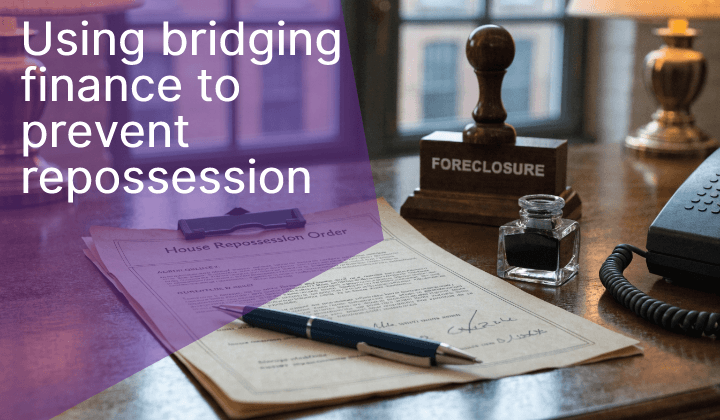
Missing mortgage payments or going deep in arrears can get out of hand very quickly in the UK property market. Once proceedings begin, that being the lender has initiated repossession, it can quickly become increasingly stressful with each demand letter placing further strain mentally and financially.
Bridging loans to stop repossessions can be a lifeline for some homeowners who are struggling with their finances and may be in arrears with their mortgage payments. It may not be for everyone, but it can be very useful in getting some breathing space to sort out finances and get back in control.
When repossession risk becomes real
Repossession threat often won’t come as a complete surprise. Normally, they tend to arise as a consequence of missed payments and built up debt that has not been dealt with.
Along the way, there might be formal notices and, in some cases, the start of court action. Once the threat of court action arises, the individual might only have a limited amount of time to deal with the debt.
In the UK, there might be an opportunity to use a short-term loan to stop the repossession of the property. This might be used to quickly pay off the outstanding debt, which might stop the repossession of the property.
Timing is everything, and acting sooner rather than later provides far more options than acting when things are at crisis point.
How bridging loans can help clear arrears
A bridging loan is usually a secured loan that is short-term, lasting from several months to two years.
Unlike the focus of income affordability, bridging focuses on the value of the property used to back the loan and the repayment plan agreed on.
This approach is quick, allowing funds to be arranged in a fraction of the time it takes with conventional financing.
At times, after valuation and due process, bridging funds can be arranged in as little as weeks.
The loan can be used to pay off debts or refinance with the current lender.
After the pressure has been eased, the focus can be turned to long-term solutions.
Example of a repossession prevention scenario
A local landlord owns a rental house that is worth £320,000. There is still a mortgage balance held on the building that currently sits around the £180,000 mark. Facing unforeseen financial problems, the landlord fails to make payment on time, and the arrears quickly rise to £15,000. This leaves the lender with no choice but to begin repossession. Although their is high equity in the house, the landlord cannot immediately clear the arrears from their rental income alone.
Bridging finance gives the landlord a short-term remedy to clear the outstanding arrears owed. It pays off the lender before things come to a worse state. This provides the landlord with time to clear the outstanding balance through a new mortgage or sell the house to recoup what they owe the bank or lender in question.
If the landlord was not to use the bridging finance, repossession could have led to the house being sold at a low price.

Security requirements lenders usually consider
Bridging loan lenders place great emphasis on the property used to back the loan should repayment be in doubt.
So, it is important that the borrower has sufficient equity in the property to provide backing for the loan amount needed.
Loan to Value (LTV) rates range from 60% to 75%. The rates may differ depending on the property and lender.
For example, in a £300,000 property, the bridging loan may range from £180,000 to £225,000 depending on the lender’s policy.
Another factor that bridging loan lenders take into account is how the borrower plans to pay off the loan. This could include refinancing, selling the property, and paying off the loan with other assets.
Risks borrowers should understand
Bridging loans can prove to be extremely useful in critical situations, but they are not without risk.
Generally, bridging loans have higher rates compared to regular mortgages, and this is because they are designed to fulfill short-term requirements.
If the borrower is not able to refinance or sell the property within the stipulated period, the loan can become expensive if the loan period is stretched.
However, bridging finance should only be taken if there is a clear exit strategy. If not, the loan can end up becoming a burden.
Is bridging the right option for repossession threats?
In most cases, yes, but it could well be it is not always the right one.
It may not be best suited, should:
• the property have very little to no equity to play with
• the borrower has no realistic exit to repay the money immediately
• getting a refinance in place is extremely limited or difficult
In these cases, getting sound advice or speaking directly with your lender may be the best first step to see what options you have.
Every repossession situation is different and they should be assessed carefully before you decide to bring on any further secured borrowing.
Alternatives worth exploring
Before resorting to bridging finance, there are other avenues that should be explored.
In some cases, negotiations to come to an agreement with the existing lender can halt repossession proceedings in their tracks.
If you can prove that you can afford to do so, then refinancing through a specialist lender could also be an option.
Selling the home can also result in a more favorable outcome than repossession, depending on the level of equity that is within it.
However, in situations where timing may not be on your side and repossession proceedings have already been started, this type of finance can provide a way to regain stability as the provision of instant funds will give you the opportunity to meet mortgage payments or other pressing debts quickly.
How Goldhill Finance can help
We have a wide range of specialist lenders who understand just how time-sensitive property loans are, and should there be a risk of repossession, we can work with you to evaluate whether a bridging loan could be just what is needed, taking into account such factors as the value of the property, the amount owed, and a plan to pay it off.
We can provide funding to help settle outstanding balances promptly, providing a route to refinance or sell the property in a better situation.
Final thoughts
The threats of repossession can escalate quickly once the lender starts to take formal action. Getting in front of it, however, can unlock many more avenues to deal with it.
If there is some equity in the property and a workable plan to pay it back, then a bridging loan can be used as a temporary measure to stop repossession.
Bridging finance, while it does need to be thought about, can be used to secure the breathing space that is necessary to get back on financial feet and protect a valuable asset.