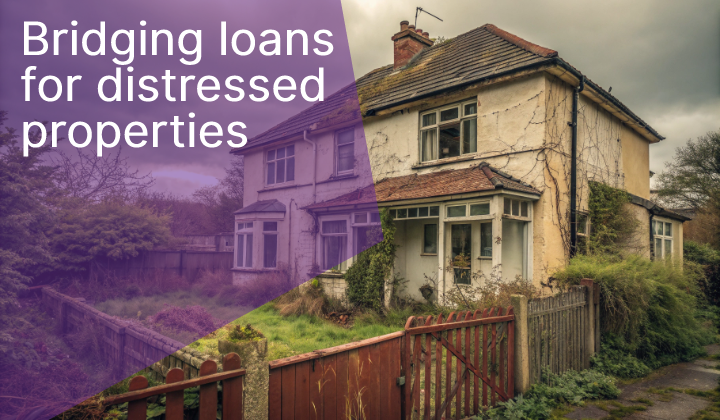
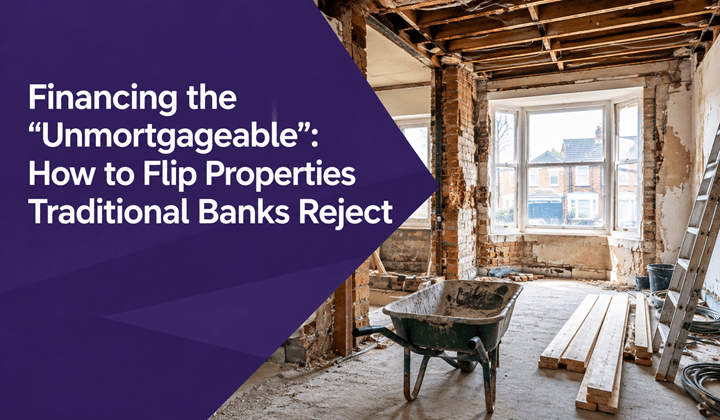
Walk into any auction house on a Tuesday morning and you will see the same pattern play out. The three-bedroom semi with a full kitchen and no visible damp goes for close to guide price, with half a dozen bidders pushing it up. Then the next lot comes up: a fire-damaged terrace with no bathroom, exposed joists and a partially collapsed rear wall. The room goes quiet. Two bidders. It sells for tens of thousands below what it would fetch in habitable condition.
That gap between what a wrecked property costs and what it is worth once repaired is where most flipping profit lives. It is also exactly the gap a high street mortgage lender will not touch. This is where bridging finance, and specifically a refurbishment bridging loan, becomes the tool that turns a derelict building into a saleable, mortgageable asset.
Why mainstream lenders reject these properties
A standard residential mortgage is not really a loan against bricks and mortar. It is a loan against a habitable home that a surveyor is willing to put a value on today, with the lender able to sell it easily if a borrower defaults. That means most banks and building societies will decline an application outright if the property has:
- No working kitchen or bathroom
- Structural movement, subsidence, or a compromised roof
- Fire, flood, or storm damage that has not been repaired
- Missing floors, exposed wiring, or no functioning heating
- Non-standard construction that surveyors are cautious about
None of this makes the property worthless. It makes it unmortgageable in its current state, which is a very different thing. A property with a missing kitchen is often a property that needs a kitchen fitting, not a property with no future.
Refurbishment financeComplete refurbishment worksPerfect for investors and BTL landlords to improve properties to increase yieldWhy refurb loans?Light refurbHeavy refurbCommercial and BTL propertyGet refurbishment fundingWhy “unmortgageable” stock is where the value Is
Because so few buyers can raise a mortgage on these properties, the pool of competing bidders shrinks to cash buyers and investors who already know how to fund a purchase without a high street lender. Sellers, executors and repossession agents often need a quick, certain sale, and price accordingly. That combination of a smaller buyer pool and a motivated seller is what creates discounted purchase prices in the first place.
The strategy, in theory, is simple: buy below market value because the property cannot be mortgaged, carry out the works needed to bring it up to standard, then either sell it on or refinance it onto a standard buy-to-let or residential mortgage at its new, higher value. In practice, the part most investors get stuck on is the middle step. Structural repairs, a new kitchen, rewiring and a new bathroom all cost money, and that money is usually needed before a mortgage lender will even consider the property.
How bridging finance closes the gap
This is the actual function of a bridge in bridging finance. It is short-term funding secured against the property that exists specifically to cover the period between “unmortgageable” and “mortgageable”. Unlike a residential mortgage lender, a bridging lender is not primarily concerned with whether the property is habitable on day one. The lending decision is based on the current value, the cost of the works, and the projected value once those works are complete, often referred to as the gross development value.
A bridging loan for refurbishment is built around this exact scenario. It releases funds to complete the purchase and, in most cases, releases further funds towards the cost of works, either upfront or in stages as the project progresses. That structure means an investor is not required to fund the entire renovation from savings before the property becomes attractive to a conventional lender.
Light refurbishment versus heavy refurbishment
Not every unmortgageable property needs the same level of work, and lenders generally split refurbishment projects into two categories.
- Light refurbishment covers cosmetic and non-structural work: a new kitchen and bathroom, rewiring, replastering, new flooring, and general modernisation. These projects tend to move quickly and are the most common route for investors flipping a single property.
- Heavy refurbishment involves structural changes, such as removing load-bearing walls, extensions, loft conversions, or full rebuilds following serious damage. These projects usually take longer, carry more risk, and often require planning permission or building regulations sign-off. Larger or more complex schemes like this sit closer to property development finance, which is structured around staged drawdowns against a build programme rather than a single renovation.
Knowing which category a project falls into matters, because it shapes both the loan structure and the timeline an investor should be planning around before they even make an offer.
From wreck to remortgage: The practical route
Most successful flips of unmortgageable stock follow a similar sequence.
- Find and secure the property. Derelict and structurally damaged properties are frequently sold at auction, where completion is typically required within 28 days. This tight deadline is one of the main reasons cash or bridging finance is needed rather than a mortgage, which can take months to arrange. If the purchase is coming from an auction, auction property finance is built around meeting those short completion windows.
- Arrange the bridging loan before the deadline. Because a bridging lender is not waiting on the property to meet mortgage criteria, decisions and funds can move considerably faster than a standard mortgage application.
- Carry out the works. Funds for the refurbishment are usually released in stages as work is completed and verified, rather than as one lump sum, which keeps the lender’s exposure in line with the rising value of the property.
- Exit the bridge. Once the property is complete and mortgageable, the investor either sells it on the open market or refinances onto a standard buy-to-let or residential mortgage, using those funds to repay the bridging loan in full.
That final step, the exit, is the part a lender will scrutinise most closely before agreeing to lend at all. A bridging loan is only ever a bridge; it needs a clear route off the other side.
Secured finance on your propertyLend money against your propertyAs long as you own a home and need funds for investment or business, we can helpHow funds can be usedBusiness investmentCommercial purchasesProperty refurbishmentYes, I own a propertyWhat this type of finance costs, and what to weigh up
Bridging finance carries higher interest rates than a mortgage, which reflects both the short-term nature of the lending and the condition of the security property. Costs to budget for typically include the arrangement fee, monthly interest (which can often be rolled up and paid at the end rather than monthly), and the exit or redemption when the loan is repaid. Running the numbers before making an offer, rather than after, is what separates a profitable flip from a project that eats its own margin. A bridging calculator is a useful starting point for working out roughly what a project will cost to fund before submitting an application.
It is also worth understanding whether a particular loan falls under regulated or unregulated lending, since this affects how the loan is structured and what protections apply.
Is flipping unmortgageable property right for you?
This strategy suits investors who are comfortable managing a renovation project, have a realistic contingency built into their budget, and have already thought through how the loan will be repaid before they buy. It does not suit anyone hoping to raise all the funds after exchanging contracts, or anyone unwilling to allow for the fact that structural work on an old building rarely goes entirely to plan.
For investors who fit that profile, though, the properties everyone else walks past at auction are often the ones with the widest margin between purchase price and finished value.
Next steps
If you have found a property that a mortgage lender has turned down, or you are planning to bid on one, get in touch with our team to talk through how a refurbishment bridging loan could be structured around your project.