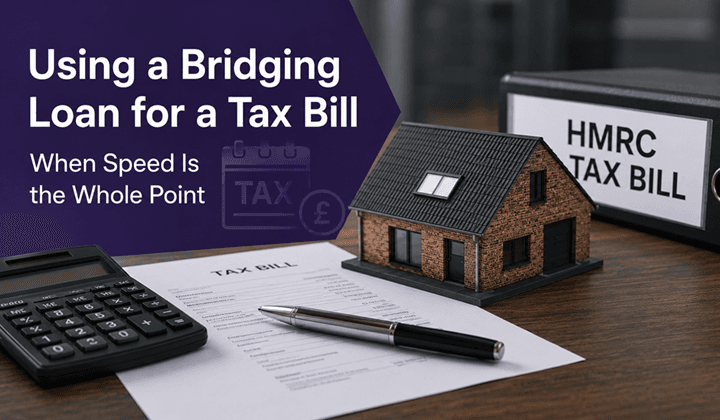
A tax bill is rarely a shock in principle. The date is set months in advance and the figure is usually predictable. What catches people out is timing. The money is tied up in a property, a pending sale, a slow-paying client or a refinance that has not quite completed, and the deadline arrives regardless. That gap between what you owe and what you can actually reach is where a bridging loan can earn its place.
Before looking at how bridging works for tax, it is worth being honest about what waiting costs, because that is the number that changes the decision.
What a late tax bill really costs
HMRC charges late payment interest at the Bank of England base rate plus 4 per cent. From 9 January 2026 that rate is 7.75 per cent. It is simple interest, charged daily from the day after the payment was due until the balance is cleared, so a bill left outstanding does not sit still. It grows every day.
Interest is only the first layer. Penalties are separate and stack on top, and they escalate the longer a balance stays unpaid. A Self-Assessment payment left outstanding attracts a penalty at 30 days, with further charges at six and twelve months. VAT and other taxes have their own penalty structures, but the principle is the same across the board: the cost of delay rises in steps, not in a smooth line.
Then there is enforcement. HMRC has restarted direct recovery of debts, which allows it to take money owed straight from a bank or building society account where a taxpayer can pay but does not. For a limited company, an unpaid liability can lead to a winding-up petition. None of this happens overnight, but it is the direction of travel once a bill is ignored, and it is why prompt payment tends to be the cheaper path even when the cash is genuinely awkward to find.
Urgent business fundsBusiness finance for urgent situationsAs a business owners, unepxected situations need fiannce quicklyHow we help businessesExpanding workforceMaking bill paymentsStock purchasesLet us help your businessThe tax bills that most often create a cash squeeze
Almost any liability can arrive at the wrong moment, but a few show up again and again.
Self-Assessment is the classic one. The balancing payment falls on 31 January, and for many people a payment on account lands on 31 July as well, each roughly half of the previous year’s bill. Two large demands in the same tax year can be difficult to plan around, particularly for the self-employed and for landlords whose income does not arrive evenly.
Capital gains tax on UK residential property is another. A gain on a sale must be reported and paid within 60 days of completion, which is a short window if the proceeds have already been committed to the next purchase.
VAT bills catch businesses out when a strong quarter of invoicing collides with the reality that customers have not yet paid. The VAT is due on what has been billed, not on what has landed in the account.
Corporation tax is due nine months and one day after the end of the accounting period, which often coincides with reinvestment. Companies have their own set of deadlines and consequences, and we cover the company side in more depth in our guide to using a bridging loan to pay an HMRC tax bill.
Where a bridging loan fits
A bridging loan is short-term finance secured against property. Because the lending decision rests on the value of the security and the strength of the repayment plan rather than on lengthy affordability checks, funds can be arranged in days rather than the weeks a traditional facility can take. That speed is the entire reason it suits a tax deadline. The bill has a fixed date, and the loan can be in place before that date passes.
The structure is straightforward. The loan clears the tax now, and it is repaid from a defined exit shortly afterwards, usually a property sale, a refinance onto a longer-term mortgage, or an incoming lump sum that is already on its way. A company director facing a VAT or corporation tax deadline is in a slightly different position, and an urgent business loan secured against commercial or residential property can release the funds needed to settle the bill before interest and penalties take hold.
The point is not to replace long-term borrowing. It is to buy a clean, predictable window so a deadline does not force a rushed sale or a missed payment.
Bridging loan or a Time to Pay arrangement?
Before arranging any finance, it is worth weighing a bridge against HMRC’s own Time to Pay arrangement, which lets a taxpayer spread a bill over an agreed period. For a smaller liability with no urgency, Time to Pay is often the sensible first call, and it costs nothing to ask.
There are two things to keep in mind. Late payment interest normally continues to run on the amounts still outstanding under a Time to Pay plan, so spreading the bill does not switch off the 7.75 per cent charge. And an arrangement is granted at HMRC’s discretion, which means it is not guaranteed and can take time to agree.
A bridging loan works differently. It settles the whole bill immediately, which stops HMRC interest and penalties on that liability altogether, and it puts the repayment timetable in your hands rather than HMRC’s. The trade is that a bridge carries its own cost, so the comparison comes down to the size of the bill, how quickly your exit will arrive, and how much certainty you need.
Secured finance on your propertyLend money against your propertyAs long as you own a home and need funds for investment or business, we can helpHow funds can be usedBusiness investmentCommercial purchasesProperty refurbishmentYes, I own a propertyA worked example
Consider a property investor who sold one flat earlier in the tax year and rolled the proceeds straight into buying and refurbishing another. The refurbishment absorbed the cash, and the capital gains tax on the first sale, together with the wider Self-Assessment bill, is now due on 31 January.
The exit is clear. The refurbished property is due to be refinanced onto a buy-to-let mortgage in around eight weeks, releasing more than enough to cover everything. The problem is purely the eight-week gap.
A bridging loan secured against the investor’s existing unencumbered property covers the tax bill in full before the deadline. The refinance completes as planned, repays the bridge, and the investor avoids months of accruing interest and the penalty that would have hit at 30 days. The tax is paid on time, and the cost of the bridge is a known, contained figure rather than an open-ended liability to HMRC.
When a bridging loan is the wrong tool
Bridging is not the answer to every tax bill, and it is fair to say so.
If there is no realistic exit, a sale that may or may not happen, or a refinance that is far from certain, then short-term borrowing simply moves the problem forward and adds cost. A bridge needs a repayment plan you can actually rely on.
If the bill is modest and you have breathing room, the fees on a bridging loan may outweigh the interest you would save, and a Time to Pay arrangement is likely to be cheaper. And because the loan is secured against property, it should only be used where you are comfortable with that security and confident in the exit. The right question is not whether a bridge can clear the bill, because it usually can, but whether it is the most sensible way to do so in your circumstances.
The practical next step
A tax deadline is one of the few dates you can see coming, which makes it one of the easier problems to solve if you act before it arrives. If you own property with equity and have a clear repayment route, a bridging loan can turn a pressing bill into a short, managed gap.
If you are weighing your options, speaking to an experienced broker will tell you quickly whether bridging fits your situation or whether another route serves you better. Either way, the earlier you look at it, the more choices you have.