
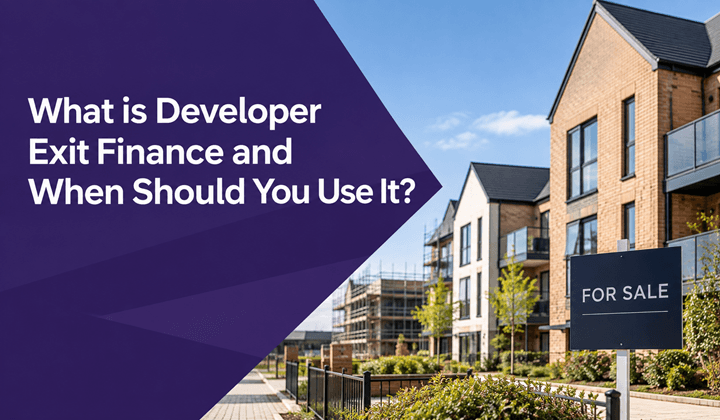
The building work is done. The scaffolding has come down, the site has been signed off, and the units are on the market. Yet the development loan that paid for the construction is still running, still charging interest every month, and still needs to be repaid in full. This is the gap that catches a lot of developers out, and it is exactly where development exit finance earns its keep.
If you have ever watched a development loan roll past its original deadline while units sell off one at a time, this article is for you.
What development exit finance actually is
Development exit finance is a short-term loan used to repay an existing development loan once a build has practically or fully completed. Rather than continuing to pay a development rate, which is priced for the risk of construction, you move onto a lower-risk facility priced for the risk of holding and selling finished stock.
The lender is no longer looking at planning permission, build costs or contractor risk. They are looking at a completed asset with a practical completion certificate, or very close to it, and a realistic sales plan. That lower risk profile is usually reflected in a lower monthly rate.
It is worth being clear on what this product is not. It is not a way to fund further building work, and it is not the same as property development finance, which is designed to get a scheme built in the first place. Exit finance picks up once the hard part is over.
Why developers reach for it
A development loan is priced on the basis that the lender is taking construction risk. Once the building is finished, that risk has gone, but many developers are still sitting on the original facility because the units have not sold yet. That means paying a construction-level rate for a finished building, month after month, while waiting for buyers to complete.
There are a few situations where this becomes a real problem rather than a minor annoyance:
- The original loan term is running out. Development loans are typically arranged for a fixed period, and lenders charge default rates or exit penalties once that term is breached.
- Sales are taking longer than forecast. Even a strong scheme can be affected by a slow local market, mortgage delays on the buyer’s side, or a chain further down the line.
- Capital is needed for the next project. Waiting for every last unit to sell before starting a new site means dead time between developments, which most developers cannot afford.
- A small number of units remain unsold. Extending an entire development facility to cover the last two or three plots is expensive and disproportionate to the risk actually left on the table.
How it reduces monthly interest costs
This is the part that makes exit finance worth investigating rather than simply extending the development loan and hoping the sales pick up speed.
Development finance rates are built around construction risk: the possibility of delays, cost overruns, and a project that does not reach completion. That risk premium does not disappear just because a lender agrees to extend the original term. An extension on a development facility is usually priced close to the original rate, sometimes with an extension fee on top, because the lender is still carrying the same risk category on paper.
Development fundingDevelopment financeRaise the capital needed to build or complete developments or land purchasesDevelopment loansReleased in drawdownLand purchaseDevelopment costsDevelop todayExit finance is priced differently because the risk is different. The building already exists, valuation is more straightforward, and the exit route, a sale or refinance, is close at hand rather than months away. Lenders reflect that with a materially lower monthly rate.
Set against a scheme with, say, £400,000 still outstanding and six months left to sell the remaining units, even a modest reduction in the monthly rate adds up quickly over that period. On a facility of that size, moving from a development rate to an exit rate can be the difference between the final units generating a healthy return and barely covering their own holding costs.
There is a second saving that is easy to overlook: many exit facilities allow interest to be rolled up rather than paid monthly, which keeps cash in the business while sales complete, rather than tying it up in loan servicing.
When it makes sense to use it
Exit finance is not the right tool for every stage of a development. It tends to make the most sense in a specific set of circumstances:
Practical completion has been reached, or is imminent. Lenders will want evidence that the build is finished or nearly finished, usually through a practical completion certificate or a final inspection from a monitoring surveyor.
The current loan term is close to expiry. If a facility is due to end in the next one to three months and the units are not yet sold, refinancing onto exit finance before the term lapses avoids default rates.
A handful of units remain unsold. Where most of a scheme has completed and sold, exit finance against the remaining stock is usually more cost-effective than extending finance across a whole development.
Capital needs to be released for a new site. Some developers use exit finance not just to reduce cost, but to release equity from a finished scheme so the next plot can be secured without waiting for every sale to clear.
It is generally less suitable at the very start of the marketing period, before there is any sales activity to point to, or where the build still has significant work outstanding. In those cases, the original development facility, or an extension of it, is usually the more practical route.
Development exit finance vs commercial bridging finance
Development exit finance is, in practice, a form of short-term secured lending, and it sits close to commercial bridging finance in how it is structured: secured against the property, assessed on the value of the asset and the strength of the exit, and arranged to be repaid once a sale or refinance completes.
The distinction is mainly one of purpose rather than mechanics. Commercial bridging finance covers a broad range of situations involving commercial or semi-commercial property, from buying premises to refinancing an expensive facility. Development exit finance is a specific use of that same short-term lending principle, applied at the point a development scheme has finished building and needs to move from construction funding into a lower-cost holding position.
What lenders will want to see
Getting exit finance in place quickly comes down to having the right information ready. Most lenders will ask for:
- Evidence the build is complete or practically complete
- Current valuations for the remaining unsold units
- A record of sales already achieved, including agreed prices where available
- A clear, realistic timeline for selling or letting what is left
- Details of the existing development loan being repaid
Because the lender is assessing a finished asset rather than a construction project, this process is generally quicker than the original development application, and a desktop valuation is often sufficient rather than a full site inspection.
Getting the timing right
The biggest mistake developers make with exit finance is leaving it too late. Waiting until a development loan has already breached its term means dealing with default interest while a new facility is arranged, which erases much of the saving exit finance is meant to deliver. Speaking to a lender in the final weeks of the build, once completion is in sight, gives enough time to have terms agreed and ready to draw down the moment the original facility needs repaying.
If your development is nearing completion, or you already have unsold units sitting on a loan that has run past its intended term, it is worth working out what an exit facility would cost against what you are currently paying. In many cases the numbers make the decision straightforward.
Get in touch with our team to discuss your development and see what an exit facility could look like for your scheme, or use our bridging loan calculator to get an initial estimate of costs.